| “Roger Casement –the real and the fabricated” Jack Lane:text of a talk at the Mother Jones Festival, Cork, 26 July 2025 |
Aubane Historical Society
Roger Casement remains a compelling figure in Irish and British history. This year is the 60th anniversary of his re-interment. He has become an icon for many causes. But icons are lifeless things and are deprived of context and thus of any real historical meaning. But Casement remains highly relevant because of what he said and did. After 49 of his 52 years as an active participant and onetime poster boy for the British Empire he became the most dangerous Irishman that the Empire ever faced. Why did this happen? That is why he was hanged and that is why there has been a consistent attempt for over 100 years since to traduce his moral significance. This attempts to put the record straight.
Contents
“Roger Casement – the real and the fabricated” Jack Lane
Annex
Great War Factsheets Pat Walsh
“Roger Casement – the real and the fabricated”
Jack Lane
Aubane Historical Society
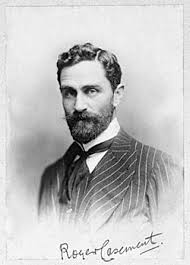
“Roger Casement – the real and the fabricated”
This talk is a very brief outline of the case for the real Roger Casement and why we are now presented with a fabricated or concocted version of him.
Like some people here, and anyone of my vintage in particular, I was introduced to Casement at the time of his re-interment in 1965.
Two events stand out for me at the time. A meeting in University College Cork addressed by Dr. Herbert Mackey on the ‘Black Diaries’. At the time he was the leading proponent of the forgery thesis of the diaries.
That meeting was chaired by the then very radical and ostentatious Republican, friend and admirer of Tom Barry – Eoghan Harris. In his FCA trench coat he would perform at the Philosophical Society and seemed a reincarnation of Barry! And delighted to be regarded as such!
How times have changed! Oh, how people have changed.
The other event was de Valera’s Address at the re-interment ceremony, at which he said:
“It required great courage to do what Casement did, and his name would be honoured, not merely here, but by oppressed peoples everywhere, even if he had done nothing for the freedom of our own country.”
This was true of course and de Valera was no doubt referring to Casement’s humanitarian reputation. But it left me with a bit of a puzzle. Why exactly was he hanged and his name blackened ever since—and why is it still ongoing? Surely he was not hanged for his humanitarianism—which was carried out by him on behalf of the Empire. (He went to Putumayo at the specific request of his close friend, Sir Edward Grey, the Foreign Secretary; and Casement did an excellent job as usual—but that did not prevent Grey sanctioning his execution as a leading member of the cabinet that did so in 1916.)
Casement did his job and Grey did his job.
OPPOSITION TO THE RISING
And there was a further puzzle. Was Roger Casement hanged for his part in the 1916 Rising? Not likely as he played no part in it, being in custody at the time. He came back from Germany to oppose the Rising—and the British knew this very well and prevented him from getting this message to the Irish Republican Brotherhood [IRB]leaders after he landed at Banna Strand.
So they hardly hanged him for that—for opposing the Rising? They should have applauded him rather than hang him, surely?
So the puzzle remained.
Casement’s contribution to the Rising was echoed with just a few words in the Proclamation, where it refers to support for “our gallant allies in Europe” i.e., the Germans, a sentiment which Connolly also endorsed—though they never met—and Connolly ensured it was in the Proclamation.
But those few words were the key to get an understanding of Casement’s political position then, and his fate. That phrase unlocks what Casement really was at that point, and what he meant to the British then and since.
His was clearly not the simple Irish Republican Brotherhood position of England’s difficulty being Ireland’s opportunity. And I am not of course criticising that IRB approach – just that it was not Casement’s.
Now, Casement’s opposition to the Rising was quite understandable from his then point of view: he knew that this would be a declaration of war on the Empire, and what matters in war is military success and any other approach is reckless. He knew enough about how the British Empire was built to appreciate that. The sword was mightier than the pen in the building of that Empire!
The likelihood of military success is also a condition for a ‘just war’, as any Catholic theologian will tell you. It is immoral to start a war you cannot hope to win.
Of course, despite being a military failure, 1916 turned out to be a political success as events developed and confirmed the validity of its purpose. The 1916 leaders could claim to be successful in beginning the end of the British Empire: but there seems to be a sense that all is forgiven them by the Empire! But for British historians and commentators it is clear that this not the case with Casement.
Why?
CASEMENT’S IMPERIAL CV
A regular series of books have been appearing since the 1950s that keep painting a very negative picture, shall we say, of him. Vilifying him, in fact. Though he had faithfully served the Empire and opposed the Rising? What is going on?
To get an understanding of this, we should begin by reminding ourselves that, for about 49 of his 52 years, Casement was a committed and active British Imperialist ‘at the top of the tree’ in the British Establishment with a worldwide reputation.
He was a British Consul in ten different locations across two continents, was given the Queen’s South Africa medal for his “special services, 1899-1900” in the Boer War, was made a CMG in 1905, Knighted and given the Coronation Medal in 1911. Not many got such honours. Erskine Childers, another prominent Imperialist did not get them.
Casement was the ‘go to man’ for dealing with some problematic issues for the Empire. He was in fact a poster boy for the Empire, exposing evils in the world such as the Belgian atrocities in the Congo, and the atrocities of the rubber/robber barons in Peru.
In supporting the War on the Boers, he was at odds with the Irish Republican Brotherhood and with Irish public opinion which vehemently opposed that war.
CASEMENT AS A CULTURAL NATIONALIST
Casement was an Irish cultural nationalist around the turn of the 20th century and, as with everything he did, he put his heart into it. Purely cultural nationalism is quite compatible with British Imperialism—and with any Imperialism worthy of the name! The Empire can thrive by encouraging such nationalism—as it can be quite containable politically because, in itself, it is non-political and can remain “inside the box” of the Imperial ambit.
This did not put him at odds with the Empire. So he was not hanged for that.
HOME RULE AND THE IRISH VOLUNTEERS
Casement supported Home Rule and he helped organise the Irish Volunteers to bring it about, in the face of Ulster military resistance. The IRB played a part in this but only a bit part at this stage. The proof of this is that Volunteers were taken over by Redmond and Casement supported that takeover.
The Howth Gun Running was an Anglo-Irish achievement: with Casement and others to help the Government militarily ensure Home Rule. The Volunteer forerunners of the IRA came into existence to help the British Government achieve its then aims.
All this was quite compatible with Imperialism as the ‘progressive’ Imperialists such as Cecil Rhodes, the greatest of them all, saw Home Rule as helping to consolidate the Empire and he supported it financially and otherwise.
Of course the IRB had other ideas but they did not then determine things, as Redmond’s take-over with Casement’s support proved and events did to yet fall their way. They infiltrated the Volunteers—as they infiltrated everything that moved in Irish national and cultural spheres at home and abroad—but they were not then the driving force they later became.
What Casement was doing at that stage was fully consistent with what he then was, an Imperialist, and there is no need for any convoluted explanations for his behaviour as if he was some sort of enigmatic self-contradictory figure.
He was helping to update Ireland’s role as a member of the Empire, as Redmond was also doing with Home Rule. Like millions of others for generations he saw the British Empire as a laudable and worthwhile project and served it with great, if sometimes critical, loyalty—and he was not hanged for that.
Again this activity with the Volunteers did not put him at odds with the Empire.
SO WHY BREAK WITH THE EMPIRE?
Why then did Roger Casement begin to break with the Empire, shortly after being knighted? And why was he hanged a few years later for High Treason to the King and Empire that had knighted him, an honour which he had accepted with fulsome thanks?
His disenchantment seems to have begun with his research into the atrocities in the Putumayo which were even worse than those of the Belgian Congo in terms of torture, floggings, mutilation and killing of the native population. But this time the rubber industry was sustained and dominated by British capital investment, companies such as the main one, the Peruvian Amazon Company, listed as the largest member on the London Stock Exchange. Rubber was like oil, another “black gold” of the era.
So it was not nasty little Belgium and King Leopold this time! Others knew of all this but Casement saw it as it as an intrinsic part of the Imperial system he represented and he began to question the raison d’être of the Empire itself.
THE PLANNED WAR ON GERMANY
But, crucially, Casement also began to realise that there was a much bigger and a more consequential horror in the offing than anything he had witnessed in the Congo and Peru. 16 million dead and 21 million woundedwas to prove him right. This was when he began to realise that alienation in writings from about 1913 onwards and they were put out in his only published book, “The Crime Against Europe”, which appeared just as the war against Germany began.
This is a book that is not easily available these days and rarely even mentioned by his ‘biographers’. It is available from Athol Books. It is a clear and incisive analysis of the international situation at the time, and it has stood the test of time. It is essential reading for understanding Casement and the world at the time.
He suspected the existence of this war plan for some time, while still accepting that the Empire was a constructive force for good in the world. But ,when he saw his suspicions taking shape, he saw the plan as a wanton attack on a central part of European culture and on civilisation itself. This was a crime against Europe as he succinctly put it.
WHAT WAS THE ISSUE WITH GERMANY?
Since its creation in 1871, the German Federation had become a powerful innovative force in the economic areas of life – trade and industry. (For instance, it created the pharma industry). It also brought advances in science, music, culture, philosophy, scholarship, and political progress.
Politically, Germany had the largest Social Democratic party in the world. It developed the genesis of what is now the welfare state, partly copied decades later by Lloyd George when he introduced Old Age Pensions.
It was a constitutional monarchy, like Britain: with a parliament that was directly elected by universal male suffrage on the basis of one man, one vote, and was the most progressive electoral system in Europe at that time.
As regards scholarship, the Gaelic Revival here would not have happened as it did without German linguistic scholarship, as represented by Kuno Meyer and others.
Germany had been a multitude, of at least 30 little states, with kingdoms, principalities, municipalities, cities etc.—which were united by language: so the relationship between linguistics and nationhood was of great interest to them.
It was to be an Empire of Germans only and the State was not interested in acquiring other nationalities, having no designs on any other country and certainly not on England! It was Anglophile and took great pride in the fact that their royal families were first cousins. Prussia was the staunch Protestant ally of England in the 19th century and it had ensured victory at the Battle Of Waterloo for England.
It was a qualitatively very different Empire to that of Britain and other contemporary European Empires. It would be better named as a German Union. So different was it, that the word Empire as generally understood is not appropriate. Bismarck did not even include Austria in the Union and said of the nearby Balkans that “they were not worth the blood of a single Pomeranian Grenadier.”
Being Anglophile, and after Bismarck had left the scene, some elements tried to copy England’s methods in “the scramble for Africa”, but the project was a bit late in the day and turned out to be a pathetic venture. Exceptional for Germany, but all the fashion for others.
Despite its spectacular success in less than 50 years, Germany did not cause, or get involved in any war, from 1871 to 1914. The British wouldn’t have counted the German attempt to catch up on colonialism in Africa as a ‘war’. Compare that with the many wars of the British Empire in those years—it was almost permanently at war.
As Germany was developing growing trade, it needed to develop an appropriate Navy. This was potentially a point of conflict with Britain—which relied on its Navy as a guarantee of its world trading supremacy, and prevented freedom of the seas, i.e. prevented other nations from having the trading freedom to grow to their full potential economically.
But Germany thought such problems could be solved amicably between friends—how naive they were!
The British Empire was based on compulsory free trade for others—and would try its best to counter efforts of states which wished to use Protection to develop fully national economies, as Germany was doing by following the trading principles of Friedrich List, one of the founders of the German Union.
CONNOLLY ON GERMANY
Connolly, from a completely independent standpoint to that of Casement, wrote a lot about Germany and this is a typical example written just before the Rising:
“That country had the best educated working class in the world, the greatest number of labour papers, daily, weekly, and monthly, the greatest number of parliamentary and local representatives elected on a working class platform, the greatest number of Socialist votes in proportion to the entire population. All this was an index to the high level of intelligence of the German working class, as well as to their strong political and industrial position. This again was an infallible index to the high civilisation of the whole German nation. Germany had built well upon the sure foundation of an educated self-respecting people. Upon such a foundation Germany laid her progress in peace, and her success in war. Let Ireland learn this lesson” (“Forces of Civilisation’’, James Connolly Workers’ Republic, 8 April, 1916)
And it is interesting to note that, like Casement, he regards the war on Germany as involving civilisation.
On 29th August 1914 he published “The War Upon The German Nation” in which he said that for England:
“It was determined that since Germany could not be beaten in fair competition industrially, she must be beaten unfairly by organising a military and naval conspiracy against her……remember that the war found England thoroughly prepared, Germany totally unprepared…. The British capitalist class has planned this colossal crime in order to ensure it uninterrupted domination of the commerce of the world.”
I think we can guess which side he was on in the war and it was not neutrality as is sometimes suggested because of the slogan over Liberty Hall. He did not serve the Kaiser but he certainly “served” German Social Democracy as his model for socialist development.
SO WHY DECLARE WAR ON SUCH A COUNTRY?
The war against Germany was on the cards since 1871 when Germany was first united and had defeated and repulsed France’s invasion to prevent its unification. However, under the English balance of power rules, Germany being the new power in Europe, was in the frame for being attacked by England in alliance with other less powerful states.
This was Britain’s Balance of Power strategy since the so-called Glorious Revolution, and should really be called the balance of perpetual war and conflict within Europe: thus ensuring an ongoing conflict between European states which gave England a relatively free hand to increase its power in the rest of the world to build its Empire.
Casement summed it up :
“The balance of power strategy had nothing to do with maintaining peace in Europe. Quite the contrary. It was a strategy to keep Europe in a condition of unresolved conflict—of negating Europe as a force in the world by keeping it in conflict with itself” (The Crime Against Europe).
It worked a treat. Some Imperial apologists even used to suggest it was all built by default and in a fit of absentmindedness—and that it was ‘lost’ in the same way.
The strongest Power in continental Europe at any stage, whether Spain, France, and now Germany, was to be opposed by inciting, and allying with, the lesser Powers against it.
Part of the plan to destroy Germany was to ensure it was surrounded by alliances of hostile Powers, as pointed out in detail by Casement in The Crime Against Europe—which is essential reading for anyone interested the history of the period. It has stood the test of time.
An expansionist Czarist Russia was expanding eastward, in what was Britain called the “great game”—the contest between the two Imperial Powers over control of Afghanistan and other places—as well as looking westward towards the Balkans and the carving up of the Ottoman Empire. Here the intention was to have Constantinople becoming a Russian city and centre of Orthodox world.
On the other hand, Germany wanted the Ottoman Empire modernised, not destroyed, and saw it as a necessary part of the world order for Muslims.
Within Europe in the Balkans Russia encouraged conflict with Germany’s ally, Austria (the Hapsburg Empire), by supporting Serbia’s expansion at Austria’s expense in the Balkans. Hence the basis for a conflict with an aggressive Russia.
Separately, France wanted revenge for the 1871 defeat in a war it had started with Germany, and the recovery of Alsace Lorraine which it had lost as a result—and this laid the basis for an irredentist conflict from the west. And France had an intense desire to recover its position as the main Power in continental Europe by dismembering Germany back into its constituent parts.
SPECIAL PLANNING FOR THE GREAT WAR
Britain’s special planning for the war began in earnest with the setting up of the Committee of Imperial defence in 1902 by Arthur Balfour—whose plans were kept secret from Parliament and most of the Cabinet, and therefore from Casement. Balfour was the main orchestrator of the war plans and was the ever-present power whether in or out of government. He was the personification of what today would be called the deep state. An eminence grise who exercised power without being officially in power.
“Bloody Balfour”, as he was nicknamed by William O’Brien after the “Mitchelstown massacre” when he was Irish Secretary.
As the author of the “Balfour Declaration” he gave the green light to Jewish nationalists with the unique award of a “national home” to people who did not actually live in their “national home.” And that bit of ‘statesmanship’ has worked itself out to have dire consequences ever since—including the continuing Genocide in Gaza and expansionist war against all its Muslim neighbours with no end in sight. O’Brien could hardly have given the British leader a better, if very understated, nickname.
The Balfour Declaration was a tactic to win the war against Germany and the Ottoman Empire by getting Jewish support. It ensured a conflict with, and within, the Moslem world—weakening it so that Britain could increase its power in the Middle East.
BALFOUR AND THE NEED FOR WAR ON GERMANY
Of course, we don’t need to rely on Casement or Connolly for the causes of WWI. We can go to the horse’s mouth, to the man himself, the doyen and philosopher of British politics in that era, which is what Balfour was. It is not often we hear such a person give his real views clearly on fundamental issues except in very private settings.
Of course, we don’t need to rely on Casement or Connolly for the causes of WWI. We can go to the horse’s mouth, to the man himself, the doyen and philosopher of British politics in that era, which is what Balfour was. It is not often we hear such a person give his real views clearly on fundamental issues except in very private settings.
But Balfour did so in 1907 with the American Ambassador, Henry White, who was also a long-standing personal friend. White’s biographer recounts a conversation White had with Balfour:
BALFOUR: We are probably fools not to find a reason for declaring war on Germany before she builds too many ships and takes away our trade,
WHITE: You are a very high-minded man in private life. How can you possibly contemplate anything so politically immoral as provoking a war against a harmless nation which has as good a right to have a navy as you have? If you wish to compete against German trade, work harder.
BALFOUR: That would mean lowering our standard of living. Perhaps it would be far simpler for us to have a war.
WHITE: I am shocked that you of all people should enunciate such principles.
BALFOUR: Is it a question of right or wrong? Maybe it is just a question of keeping our supremacy.
(Alan Nevins, Henry White, Thirty Years of American Diplomacy, Harper, New York, 1930, p. 257)
You will see that this admission corresponds exactly to what Connolly said about the War and Germany. But Connolly’s conclusion as an Irish Socialist was the exact opposite of that expressed by Robert Blatchford, a leading English socialist—who coined the famous catchphrase “My country right or wrong”, a view which complements Balfour’s view perfectly. Blatchford argued that the British working class were gaining so much from the Empire it should take that attitude.
I think Balfour’s view might remind you of what has become known recently as a transactional view of international affairs: The action of going to war against another state because it is more successful than yours, so that you can be better off. Sounds familiar?
This is of course a most realistic view of what is euphemistically called ‘international relations’—which in reality is dog eat dog, however sophisticated the rhetoric! We should be grateful to Mr. Trump for making that absolutely clear.
White’s exchange with Balfour also shows that the US had no problem with Germany and regarded it as a harmless nation.
WAR: RIGHT AND WRONG
Balfour’s concluding remark about right and wrong not mattering sums up in a nutshell the morality of the planned war against Germany. Right or Wrong did not come into it.
This was the exact opposite of Casement’s view—that war is always a question of right or wrong and this 1914 War was wrong. And should be opposed in word and deed.
Casement, as always, had the courage to act on what he believed in. He was not just a wordmonger:
“The rest of the writer’s task must be essayed not with the author’s pen but with rifle of the Irish Volunteer.”
(The Crime Against Europe, New York, September 1914).
He was always sincerely committed to what he believed in, and acted accordingly. He had physical as well as moral courage.
Balfour illustrated perfectly the moral bankruptcy of the Empire. Casement’s moral case against WWI has been overwhelmingly vindicated—that crime against Europe was the seminal event which has given rise to every subsequent War—right down to today’s reality of genocide in Gaza!
A war on Germany and the reasons for it, as clearly stated by Balfour, turned Casement’s view of the Empire upside down. The Empire’s raison d’etre was at an end for him. He had believed, like millions of others, that the Empire had been built to bring civilisation to barbarians. In turning on Germany it was barbarians attacking a centre of civilisation. Why?
In acting in this way the Empire was now a destructive force, rather than the constructive force he had thought it was—and worked for throughout his life.
This was the essence of his case against the War on Germany.
This realisation was, to put it mildly, life changing for him. But he was not alone in the face of this British War on Germany, as others also had to come to terms with this new situation created by Britain: they too had to change their minds and their plans.
WHAT THE WAR DID FOR OTHERS’ PLANS
Many people had to change their minds because of the War Britain declared on Germany: and they would have reacted like Keynes when he was accused of changing his mind on some issue and replied “When circumstance change, I change my mind, what do you do, Sir?”
For example, Connolly had worked on the basis of an international socialist revolution arising from a war between the Empires. This did not materialise as hoped for when war was launched. So he decided to join with radical nationalists to pursue his cause. Ireland became for him, as for Casement, “the one bright spot”—to coin a phrase from Edward Grey in another context—in having forces within it that were prepared to challenge the Empire.
Pádraig Pearse had shared a meeting with Redmond in 1912, accepting Home Rule. But he had to radically change his views in the light of new realities of the war. The Declaration of War was used to reduce the promise of Home Rule to that of a piece of paper that would never now become a reality. That is why he decided other methods were needed. Hence 1916.
Erskine Childers, also a hero of the Empire, changed his mind—but after the War—and was executed as an unrepentant republican.
THE RESULTS OF THE ‘GREAT WAR’
The war on Germany turned the world upside down and nothing has had such long-term consequences, right down the present day—the Gaza Genocide being the most extreme example today. My grandmother used to say “The world went mad in 1914 and has never been right since”. She was right up to a point. But the War was not caused by madness, but by design and the world has not recovered from its consequences. The world did not sleepwalk into that War, as is sometimes said and as Mr. Balfour made absolutely clear.
Casement’s indictment of the War has been amply vindicated by history since. That War declared on Germany on 4th August 1914 was nothing less than the pivotal event for the subsequent history of Europe and for the world with its continuing wars. That is why Casement remains relevant: he presaged the consequences of this War, an event which was in a real sense the beginning of modern history.
It led to a series of revolutions, each caused by the War—the Revolution in Russia and all that followed from that being the most significant.
The propaganda to justify the war—‘for the freedom of small nations’—which was intended to promote differences within other Empires into national movements—was ironically the very thing that led to the end of the British Empire itself: by the success of the subsequent national liberation movements that arose. The propaganda rebounded on the Empire.
As Hegel observed “History subverts the intentions of its dramatic actors.”
The US, in joining the War on the basis of support for self-determination for nations—added fuel to the flames of national liberation wars against the British, and other European, Empires.
The price exacted by the US for getting the British Empire to be on the winning side (not the winners) in that War was that in due course they replaced the British Empire, a price which Britain had to pay as it had become a debtor to the US. The US hurried up the demise of the Empire—and the end of the Empire was the cost Britain eventually paid for launching WWI and its continuation, WW2.
Britain started that War but could not finish it, as also with the Second World War. What happened to the British Empire with regard to the US justifies Kissinger’s warning that “To be America’s enemy is dangerous, to be its friend is fatal”.
The way WWI ended with a punitive Versailles Agreement ensured that another war would happen—which duly arrived with the British Declaration of War on Germany again in 1939—and the upshot of that was the destruction of Europe and Britain as World Powers. America took over—along with “the new kid on the block”, the Soviet Union, which arose from the Bolshevik Revolution of 1917 that was caused by the breakdown of Czarist Russia, Britain’s ally, under the stresses and defeats of WWI.
Between them, both Wars destroyed Europe: and Casement’s description of WWI—that began that process—proved very apt, it was: “The Crime Against Europe”.
The destruction of Europe and the undermining of the British Empire was certainly not the intention of the parties to this War but it was an unintended consequence which Casement heralded.
Hence his ongoing relevance.
THE REACTION TO CASEMENT’S CONVICTION
When convicted and sentenced to hang for High Treason, a foregone conclusion, Casement’s standing made many notable people in various walks of life seek clemency for this traitor. Sir Arthur Conan Doyle organised a petition of very distinguished people. The cream of the literati—writers such as Chesterton, Arnold Bennett, John Masefield, Jerome K Jerome, C.P. Scott (Editor of The Guardian), the Webbs; Ben Tillett, Robert Blatchford, some Professors, some Knights of the Realm, some Bishops and others. Douglas Hyde organised a similar petition in Ireland.
The Archbishop of Canterbury had spoken for a reprieve but the ‘Black Diaries’ (i.e. the police typescripts) changed his mind: and that of others. Shaw and Yeats worked for a reprieve, despite them.
Opinion in the US was so strong that the US Senate voted for a reprieve. The only comparable person in modern times with such a reputational influence would be Nelson Mandela.
Casement’s standing was so high that these eminent people, seeking clemency for him, were saying his reputation should override the High Treason verdict of execution: even though that treason was committed in the middle of a ‘life and death’ war for the Empire.
WHY THIS APPEAL FOR CLEMENCY?
This was an extraordinary situation and confirms Casement’s moral standing. His views on Germany, and against War with it, were fully shared by the leading Liberals and by Liberal opinion before the War was actually declared. But they had abandoned their position as soon as War was declared, when “the drums began to roll”. Blatchford’s cry became operative for them – “My country right or wrong.”
They betrayed and debased themselves, while Casement had remained a consistent Liberal and acted on his beliefs—and was thereby, while alive, a stinging rebuke to the moral cowardice of his fellow Liberals. In their hearts they knew he was right about Germany and the War with its horrors. And, to coin a phrase “they did not like it up ’em!” The appellants for clemency tried to salve their conscience as best they could.
Casement thereby touched a raw nerve in the English psyche—he punctured its self-righteous war morality—and that wound has never healed, and has never been forgiven. England would not be England if it did forgive him: because War is an existential necessity for England since the so-called Glorious Revolution.
Wikipedia and ChatGPT tell us that “The United Kingdom’s forces (or forces with a British mandate) have invaded, had some control over or fought conflicts in 171 of the world’s 193 countries that are currently UN member states, or nine out of ten of all countries.” This is not a complete picture as there were more than one war with/within many countries.
And since WWI these Wars have been peoples’ wars—with the masses, the democracy engaged—which was not the case previously. The masses were somewhat like spectators in earlier wars.
Such Wars could not be “sold” to the masses as transactional issues à la Belfour’s admission to the American Ambassador. So the moral case had to be the focus, i.e. the wars became wars between Good against Evil, Right against Wrong and always against demons, who appear as regular as clockwork when required right across the world. The moral self-righteousness became an absolute necessity in waging these Wars.
Casement personified the opposition to all this, in opposing the greatest war that England ever launched and labelling it a crime and supporting the enemy to defeat the Empire. Failure did not prove him wrong. This was supposed to be “the war to end all wars” but it was concluded by “the peace to end all peace” at the Treaty of Versailles.
What he did to England in puncturing its moral self righteousness about its wars was more detrimental to it than what he did for Ireland. To misquote “Shakespeare” he “did the State some disservice and they know it.”
That was the real Casement and why he had to hang.
CREATING THE FABRICATED CASEMENT
Casement had to be countered and fast. This is why the fabricated Casement had to be urgently created and promoted. It’s easy to kill a person but not so easy to kill his reputation and his ideas and their subliminal effect. So a more powerful weapon was needed to obliterate him. But what do? How to discredit such a man?
The old reliable weapon used was sex—a sex scandal. That always captures the English imagination and is part and parcel of its socio-political life. This was the well tried and often successful weapon of choice for such a purpose in Puritan England with its “nonconformist conscience”. And its use may not yet be at an end.
Within the then living memory it had worked against Dilke, Rosebery, Parnell—and had been tried earlier with O’Connell. Many more, but less famous people, before and since were treated likewise and were victims.
But, despite being one of best known people in the world, with countless friends in every walk of life across four continents, with every door open to him—and bedroom doors as well if he wished—no evidence could be found of a sex scandal.
When Devoy heard about the allegations of homosexuality coming from the Foreign Office he remarked along the lines, “I am not surprised, they know all about that. They are obsessed with it over there in that place.”
But nobody from the Foreign Office or elsewhere came forward with any information to make or confirm a scandal: despite his hundreds, if not thousands, of friends and colleagues he had known across three decades.
And it was not for the want of trying. Agents were even sent to Peru to find some evidence but to no avail (see Irish Political Review, January 2025).
As there was no evidence of such a scandal attached to Casement, it had to be created and fast: because Casement’s surprise arrival in Kerry caused consternation: this famous open, indeed proud, traitor had to be tried and dealt with as soon as possible for public morale—as the Empire was then at its lowest point in the War and it was touch and go as to whether it would win or lose.
CREATING THE BLACK DIARIES
Hence the creation of the ‘Black Diaries’ as the most potent weapon to discredit and paint such a person as one that hardly deserved to belong in society. He should become a non-person.
To fill the need, the police created typescripts of a ‘diary’ which tapped into the virulent homophobia of Puritan England. These first appeared in the Metropolitan Police’s Submission of Evidence to the Director of Public Prosecutions in mid-May1916. This is a defining document among the hundreds devoted to Casement and today it would be called the Book of Evidence for the Prosecution. A crucial document.
It is a large six-volume file that along with the police typescripts had lots of the most minute details and photographs of evidence. Included here were: a sausage wrapping of Casement’s, a German train ticket, and some scraps of notes about his journey from Germany. (Birkenhead later claimed this was his ‘Black Diary’.) There were photos of the Irish Brigade, the boat he arrived in and of Banna Strand. All supplied by the very diligent Royal Irish Constabulary in Tralee. These items became official exhibits at the Trial.
The RIC did not see fit to submit his coinage of gold and silver then about £50 and which was auctioned for £7,000 about 10 years ago. Sergeant Hearne and Constable Reilly must have considered their share a nice little bonus for an unexpectedly busy Good Friday in Kerry in 1916. Their annual salary would have been around £60.
The police threw the proverbial book at Casement — but no diary—nor even a photograph of one. For the police the most potent item of all was missing.
To mix metaphors: there was no ‘smoking gun’ but plenty of smoke (see the file at the Public Records Office, Kew: TNA DPP 1/46).
I have drawn attention to this file before (Church and State, No. 141, September 2020) and I was surprised to read on Jeff Dudgeon’s website under the “Controversies” section reference to that article in which Jeff says that this was a file “whose contents I had not been aware of.” This was amazing for such an intrepid authenticity promoter and researcher on Casement. An elephant in the room he did not see.
The police case for making a charge for the then crime of homosexuality would be laughed out of court without a diary and some witnesses – or at least one. Wiser heads prevailed to prevent such a debâcle.
HOMOPHOBIA IN VICTORIAN ENGLAND
Because different attitudes apply today, many people may find it hard to imagine the then virulent homophobia of England. Other countries did not share such a virulent phobia about homosexuality.
Just one example was a contemporary hysterical campaign led by MPs that claimed the War was being lost because the “moral fibre” of the nation was being corrupted by the Government—by Asquith and his wife in particular—in promoting a culture of homosexuality and lesbianism. It led to a famous libel case against the campaigners, but they were not convicted.
It was a readymade English version of the “The stab in the back” thesis if England lost the War (See “Salome’s last veil – the trial of the century” by Michael Kettle).
So virulent was this homophobia in Puritan England that, even 40 years later, the war hero and computing genius, Alan Turing, was chemically castrated for his homosexuality.
Some decades ago I got to know Seán McGouran, the well known, and very cultured gay rights activist in Northern Ireland for over 50 years. He regarded the behaviour attributed to a man in Casement’s position as incredible and laughable. And clearly homophobic in equating it with homosexuality.
And one need only read the behaviour of the persona created in the Government typescripts to see this and it has been well described as that of a:
“…thoroughly repugnant pederast, obsessed with the male sex organ, indiscriminately promiscuous, addicted to prostitutes, an immoral priapic sex addict… unstable and incapable of affection and ordinary discretion” (Paul Hyde interview, Irish Political Review, June 2025).
And the most lurid creations were set in Peru : exactly where the authorities tried and failed to find any evidence!
Casement was to be made an unmentionable person, a non-person. I think the behaviour created in the forged diaries would be described today as that of a serial child sex abuser.
All Casement’s countless friends and acquaintances were shocked at this portrait and not one of them ever gave it any credence: then or since.
And in this era I would guess that most homosexuals, past and present, have been ‘outed’ or ‘come out’ and are now proud of that. But Casement does not appear anywhere in that category.
CASEMENT ON SEX
In one of his most passionately honest entries in a genuine diary—when reflecting on the genocidal behaviour of the gangster owners of the company he was investigating (mentioned earlier) in Peru—he bared his soul, confessing that:
“I swear to God, I’d hang for every one of these band of wretches with my own hands if I had the power to do it with the greatest pleasure. I have never shot game myself with pleasure. I have in fact abandoned all shooting for that reason, that I dislike the thought of taking life. I have never given life myself to anyone and my celibacy makes me frugal of human life but I’d shoot or exterminate these infamous scoundrels more gladly than I should shoot a crocodile or kill a snake” (29/9/1910, “The Amazon Journal of Roger Casement”, edited and published by Angus Mitchell).
Nobody ever accused Casement of hypocrisy and nobody could honestly believe that the person who confessed the above could be harmonised with the rampant sexual behaviour of the Black Diaries.
In the pre-Freudian world people were not as defined by sexual activities or orientation, as is common today. Celibacy was not then regarded as some sort of affliction as it is now. It was in those days a choice often made for many reasons.
SUCCESS OF THE VILIFICATION IN IRELAND
But the vilification worked for the purpose at hand and Casement was hanged. It was challenged in Ireland for generations but the lurid story has now become accepted here as a depiction of the real Casement.
The success of this vilification here was confirmed for me by RTE’s ‘resident historian’, Myles Dungan, just last September 29th. I was taken aback, listening to his interview with Casement’s latest ‘biographer’, Roland Philipps, on RTE Radio 1. Dungan concluded the interview by saying that it was obvious that Casement had “mental health issues” (RTE, Radio 1, 29 Sept. 2024).
The claim is ridiculous. A person with such a psychological condition would most likely be at his lowest point when convicted and facing the hangman. But anyone who has ever read Casement’s speech from the dock—and Dungan must have done that—must know that it was one of the most powerful and well-argued speeches ever made—and that is how it was described recently by Norman Lamont, a former Tory Chancellor of the Exchequer in the UK.
Casement’s analysis of the legal basis of the case against him showed it to be farcical. His philosophical and historical narrative justifying what he had done in opposing the War was so searing an indictment of his Prosecutor, Birkenhead, the powerful Attorney General, that it drove him from the courtroom. Hardly the indication of a person with mental problems.
Dungan was faithfully reproducing the portrait created by the Casement recent biographer, Roland Philipps—who he was interviewing—which in turn was essentially repeating the case made by Birkenhead at the Trial—that Casement was a mental case. He suggested this to Casement’s Counsel as a defence and possibly avoid his execution.
Philipps’ evidence for the ‘mental health case’ is based on his own psycho-babble—and Dungun’s agreement with it speaks volumes for the puerile state of historical understanding here at the moment.
Philipps’ unique contribution to Casement studies was to claim that he planned “a doomed invasion of Ireland”. Which would also make Collins and others invaders of the country in 1916. You could not make it up.
But, as homophobia does not have the traction it once had in disparaging people, the ‘mental health affliction theory’ is getting more emphasis. This shows that the vilification of Casement is being honed and updated to suit a different audience today: Mental illness is a more comprehensive and more sustainable form of it. And, if Dungan is representative, that means it is working a treat in Ireland.
Casement cannot be left rest in peace—his disparagement must be kept up to date. Watch this space! I understand yet another biography is with a publisher in the US. He is like the proverbial stone in the shoe that is stuck in the British subconscious.
THE GOOD NEWS!
But the good news is that the most compelling and conclusive case for proving that these ‘diaries’ were forged has been made over the past 5/6 years by Paul Hyde in books, articles and on the internet. It is based on up-to-date research in the British National Archives and elsewhere.
But Paul Hyde’s main book of 2019 has not been reviewed in the MSM [Main Stream Media, ed.], or in broadcasting, or in academic or political outlets—including those that claim to be devoted to history, such as History Ireland.
Village Magazine and the Irish Political Review are the only, and honourable, exceptions. I would suggest you consult the April-May issue of Village this year for an example of Paul Hyde’s latest forensic approach, and the June edition of the Irish Political Review where I interview him. Both are available at the City Library here in Cork city.
Hyde’s main work is his book “Anatomy Of A lie – Decoding Casement”. It is available via the Internet from Wordwell Books. He has also published: “Casement: Decoding false history” (Aubane Historical Society); along with articles in Village magazine, in The Irish Political Review and on the website and Podcast at Decoding-Casement.com.
Angus Mitchell, who is today recognised as the leading Casement expert, says of the Anatomy book:
“Hyde exposes the patterns of duplicity, misinformation and selective framing which have produced the contemporary consensus… he makes the crucial distinction between the police typescripts which were shown in the weeks before Casement’s execution and the bound diaries which were not shown in 1916… biographers treat the typescripts as if they were true copies of diaries for whose existence at the time there is no independent witness testimony… the book draws to a close a century of obfuscation, secrecy, and acres of academic and speculative waffle.”
Anyone interested should get that book from Wordwell at a cost of about 20 Euro.
This talk is just a very brief outline of the real and fabricated Casement, and I look forward to any questions and discussion that time allows. The subject is wide and deep, fascinating at many levels and vital to an understanding of modern history.
Jack Lane (Aubanehistoricalsociety.com)
Annex
Great War Factsheets
No. 1: War Responsibility
- There were 3 wars that combined to make up the Great War but they were distinct and did not need to develop from one to the other.
War number 1 was the only unavoidable and justifiable one – a Balkan war involving Austro-Hungary and Serbia. Serbia was responsible for this war. As a matter of prestige Austro-Hungary had to react forcefully to the assassination of the heir to its throne by terrorists on 28th June. This was a massive provocation that had to be dealt with. Austria believed that Serbian intrigues and ambitions constituted a deadly menace to the continued existence of the Empire, and was aware that she must either curb the capacity of Serbia for further provocations or see the Empire perish. The British press was sympathetic to Vienna with the most popular paper in England saying “To Hell with Servia” and demanding it be wiped from the face of the earth, lest this rogue-state endanger the peace of Europe. The Manchester Guardian suggested it be towed out into the Atlantic and sunk. Capt. Grenfell (RN) says this about the Serbian reply: “It has been the fashion among British historians to describe the Serbian reply to the Austrian note as extraordinarily conciliatory, all but two of the Austrian demands being conceded. The present author does not take that view. The two rejected demands were the key ones that alone could have made the rest effective. All the remainder, even if nominally complied with, could easily have been evaded in practice and reduced to nullity by the Serbs. The Serbian reply, which was unquestionably drawn up with the advice of France and probably Russia, could therefore be regarded as a very skilful one designed, without making any genuine concession, to put the onus of war guilt on to the Austrians.” (Unconditional Hatred: German War Guilt and the Future of Europe by Captain Russell Grenfell, RN). Both Austro-Hungary and its German ally wished to confine war to this local Balkan context. It was in Germany’s interest to localise the Austro-Serbian dispute, so that the Serbs might be suitably dealt with by the Austrians without anyone else being involved. Russia, on the other hand, was interested in the support of Serbia and also resolved to use the Sarajevo assassination to bring on a general European war, as her actions during the crisis clearly indicate. Russia was in no way endangered by an Austro-Hungarian victory over Serbia and was assured that Vienna had no inclination toward including any more troublesome peoples in its Empire. This Balkan war would have been the only war in 1914 if Russia did not enter it. Austro-Hungary declared war on Serbia on 28th July. This was the start of the Austro-Serbian war not the start of World War I. It was not until August 6th, 2 days after the beginning of the world war, that Austro-Hungary declared war on Russia and Serbia declared war on Germany. France did not declare war on Austro-Hungary until 11th August and Britain until 12th August. This tends to suggest a disconnection between the Entente Cordiale and the Balkan war and that the real war was the one against Germany.
- War number 2 was a European war involving the Balkan participants plus Russia, France and Germany. Russia was mainly responsible for this war since it depended entirely on Russian mobilisation. Russia began mobilising on the day of the Serbian reply to Austria, 25th July, and the Tsar ordered full mobilisation on 30th July. Germany clearly warned Russia (and France) of the implications of its mobilisation and only begins mobilising itself on 31st July, the day after the full Russian mobilisation began. France was also responsible because it refused to restrain its ally Russia and actually encouraged its mobilisation. Poincaré assured Russia that it could count on France in any war on Germany no matter the issue since it wanted to engage in a European war to recover the mixed-nationality provinces of Alsace/Lorraine it had lost to Germany in its aggressive war of 1870/1. Germany was tied by treaty obligations to Austro-Hungary and could not allow its ally to be crushed by an inherently expansionist state which had no concept of borders. Once Russia refused Germany’s demand to stop mobilising its massive forces on Germany’s eastern frontier and France mobilised as Russia’s ally Germany had to mobilise to protect itself from encirclement. French mobilisation began on 26th July, 5 days before Germany began, and the French ordered full mobilisation on 1st August, an hour before German full mobilisation is ordered. Germany declares war on Russia on 1st August and France on 3rd August. This is the start of the European war but not the world war.
- War number 3 was the world war or Great War. This was Great Britain’s responsibility. If Britain had not entered the European war it would have remained a European war. The world war officially began on August 4th when Britain declared war on Germany. The Royal Navy was secretly mobilised between 23rd and 29th July by Churchill and took up pre-arranged battle stations off the German coast on August 2nd, 2 days before war was declared. The British Expeditionary force of 100,000 men was ordered to be despatched to France by Asquith on August 5th. It arrived complete in France less than 48 hours later on August 7th.
- The Great War was Britain’s war because Great Britain made it what it was. It would not have been the Great War it was without Britain’s participation. It was a war of gigantic scale and long duration. The only 2 previous world wars were also British wars (i.e. the Seven Years War of 1756-63 and the War on France of 1793-1815). The following factors provided distinctly by Britain gave the Great War its distinct character:
- The globalised maritime character was provided by the Royal Navy which had the objective of seizing German shipping and trade on a world-wide basis. No other European navy had this capacity or intention.
- The globalised land character was provided by Britain’s Imperial ambitions to seize German territory in Africa, Ottoman territory in Asia and facilitate its allies to do likewise – something which would have been beyond their capacity to do without the help of the Royal Navy and Britain’s acquiescence.
- The moral character of the war which made it unstoppable was provided by Liberal England (and Redmondite Ireland). The war was proclaimed to be about good versus evil, civilisation against the barbarian, Europe against the Hun, Democracy against autocracy etc. This gave the Great War its distinctive character which made peace attempts very difficult since there could be no negotiating with evil.
The last element was Britain’s insistence in concluding secret treaties with its allies and neutrals to draw them into the war. Parts of the middle-east, Europe etc. were promised in secret deals with France, Russia, Italy, Greece, Zionists, Arabs etc. that made peace negotiations proposed by the US and Germany on the basis of no annexations impossible to accept by Britain and its allies.
Great War Factsheets
No.2: Britain’s War
- From 1904 to 1908 there was a revolution in British Foreign policy in which England made a strategic readjustment to direct its Balance of Power strategy away from its former enemies, France and Russia, toward a new enemy, Germany.
- Germany was singled out as the Carthage to Britain’s Rome largely for reasons of commercial rivalry. German goods were outselling British goods in the world’s markets and it was capturing a greater and greater share of world commerce. Its goods had a competitive edge over British products both in price and quality and it was felt that Britain could not compete in the free market with the Germans.
- In response to the increase of its commerce and in joining the world market in which it became necessary to import food to supply its industrial workforce Germany began to construct a navy. It was a much smaller navy than Britain’s but England saw this as a threat to its command of the seas. There were public threats made by Royal Navy men, such as Admiral Fisher, to “Copenhagen” the German naval development – i.e. destroy it in port before a formal declaration of war was made as Nelson did to the Dutch fleet a century before. In response Britain doubled its spending on naval construction until it reached a quarter of all state spending and represented three times what Germany was spending.
- An Entente Cordiale was signed with France in 1904 by the Unionist Government. In January 1906 Sir Edward Grey the incoming Foreign Minister in the new Liberal Government sanctioned ongoing military conversations between the British and French General Staffs concerning cooperation in a future war with Germany. These were organised by Colonel Repington and General Henry Wilson but were done behind the Prime Minister’s back and only known about by Grey and Richard Haldane, the Secretary of State for War.
- The Entente Cordiale gave the French hope of recovering Alsace/Lorraine in a future war with Germany, aided by Britain and Russia.
- The Liberal Imperialists, Grey, Haldane, Henry Asquith and Winston Churchill had the intention of organising preparations for war on Germany behind the back of both the cabinet and parliament knowing that the bulk of the Liberal Party would be greatly opposed to such measures.
- War planning, including Royal Navy contingencies for economic warfare and a starvation blockade on Germany were planned with meticulous detail. The overall strategy was coordinated through the Committee of Imperial Defence, a cross-party body containing military specialists. Plans were also devised for war on the Ottoman Empire, including an attack on the Dardanelles and landings in Mesopotamia. As Captain Grenfell noted “Preparations for war against Germany had been in progress for ten years; intensively for three years at least.” (Sea Power)
- Haldane reformed the British Army and created a British Expeditionary Force of 160,000 that could be transported in 2 days to the left of the French line for engaging in a war with Germany. This was a revolutionary change in British military affairs. The biggest army England had put on the continent was at Waterloo in 1815 of 30,000 men. It had been a long-standing strategy not to commit large numbers of soldiers to the continent but to leave allies to do the fighting there. The Navy was concerned at this military intervention since it implied a commitment to continental warfare in conjunction with allies and a relegation of the senior service to a support role. It signified a definite and innovatory plan for war that bound Britain in to continental warfare at the French insistence. Haldane also militarised British society through the promotion of gun clubs, territorial’s, popular military lectures etc.
- In 1907 Britain concluded an agreement with Tsarist Russia involving a settling of accounts in the Great Game and the partition of Persia between England and Russia. Edward Grey sold the agreement in England as a peace policy and that was music to the ears of the Liberal backbenchers, who despite their detestation of ‘Russian autocracy’ were prepared to celebrate the agreement as securing the peace of the world. An alliance with France was, by itself, of no use to England against Germany. The great prize was also an understanding with Russia coupled with the Entente Cordiale. Britain was an island nation and it was primarily a sea power. It did not have a large army and it had opposed conscription. Therefore, it would have been impossible for Britain to have defeated Germany by itself. It needed and wanted the large French army and the even larger Russian army to do most of the fighting on the continent for it. The Russian Army was particularly important and it was seen to be like a ‘steamroller’ that would roll all the way to Berlin, crushing German resistance by its sheer weight of numbers. Britain’s main weapon of war and her instrument for the strangulation of Germany was the Royal Navy. A British blockade of Germany could only be effective if Russia was at war with her at the same time and sealing off her supply of food from the east. If not, Germany could derive an inexhaustible supply of food and materials from Eastern Europe and could not be strangled by the Royal Navy – despite its immense power. And even an alliance between England and France could not achieve the crushing of Germany since only one frontier could be blocked.
- The agreement with Russia gave the Tsar the chance to expand into the Balkans and possibly to the Straits at Istanbul where he desired an exit point for his fleet – a desire of Russia’s for centuries and the Tsar’s first strategic priority which Britain had up till then taken great care to prevent. Half of all Russian trade went through the Straits and grain exporting was essential in creating the agricultural reforms necessary to produce a stable class of Russian peasantry. Britain forbade Russian naval entry into the Mediterranean and war involved the closure of the Straits to shipping. So the Tsar was desperate to secure this outlet with British consent. Grey turned the foreign policy of a century around to organise the war alliance against Germany. In doing so he made war on, and the destruction of, the Ottoman Empire a prerequisite of the new British Foreign Policy.
- In April 1915 Grey formally agreed in the secret Constantinople Agreement, later published by the Bolsheviks, to hand over the Ottoman capital to the Tsar. The British did this to keep the Russians fighting when they showed signs of wavering and perhaps exiting the war. In doing so the British Government, in conjunction with the Tsar, ensured a catastrophe for the Russian State, and the subsequent triumph of Lenin and the Bolsheviks.
- All these secret plans, conversations and arrangements were not revealed to the cabinet until 1911 when they were partially revealed in response to the Agadir crisis and not fully until July 1914.
- Asquith, Grey and Haldane denied all knowledge of them continually to Parliament using language that was very careful but conveyed the impression that nothing was in place that committed England to a war on Germany in conjunction with France and Russia.
- John Dillon of the Irish Party subjected the Government to scrutiny on the matter but the necessity of the Home Rule alliance encouraged him and Liberal backbenchers who were suspicious to drop it.
- The fleet was mobilised to battle positions prior to the declaration of war on Germany. The British Expeditionary Force was landed in less than 48 hours in France after Asquith’s orders.
- The Royal Navy cut the German undersea cables on the opening day of the war making the Germans reliant on the British cables for communicating across the Atlantic and to other parts of the world.
- On 5th August 1914 the British war plans were revealed in a series of Royal Proclamations on the day after war was declared: It was made an act of treason for any British subject to trade with any German individual or organisation; owners of British merchant ships were warned that their ships would be confiscated if they carried ‘contraband’ between foreign ports; exporters were warned not to sell ‘contraband’ to any foreign buyers.
- The War Room which had been monitoring and plotting the position of every German naval vessel and large merchantman at eight hourly intervals since 1907 communicated its information to the Royal Navy. Within a week all German maritime trade was driven from the seas.
- Lloyds of London issued an order for all ships to proceed to the nearest British port or lose insurance cover. Any carrying foodstuffs and proceeding east were seized and their cargoes confiscated and declared ‘prize.’ All German owned ships were declared ‘prize’.
- Neutral ships were prevented from leaving British ports unless they surrendered their cargoes.
- The Blockade of Germany and Europe as a whole began.
Great War Factsheets
No.3: Belgium
- Belgium had been artificially constructed by Lord Palmerston and Britain by splitting off the Catholic French-speaking Walloon part of the Netherlands and joining it with the Flemish territory to form Belgium – an unusual thing for Protestant England to do in helping to construct a Catholic state. But such was the Balance of Power policy! The important point was to prevent the Flanders coast becoming part of France. Belgium was not a natural entity and was a state rather than a country, made up of two distinct peoples who did not like each other.
- Belgium was kept together to serve a strategic purpose for Britain, which then claimed a right of hegemony over it. Because Britain had helped create Belgium it believed it had the right to use the country as an instrument of its foreign policy (as it similarly did with Greece).
- Belgium was not as neutral as it was suggested. It was well known in Belgian governing circles that England was pursuing a secret policy of war against Germany. The Belgian Ambassadorial record tells us this. The Belgian state was really part of the political front against Germany and a kind of unofficial member of the Entente. Belgium had its own war aims of an Imperial kind – and subsequently did very well out of the spoils of victory in 1919. Prior to 1909, the Belgian army numbered 100,000 men recruited by volunteering. In 1912 Belgium adopted a military programme raising the war strength of its army to a massive 340,000. In 1913 the Belgian Parliament introduced the principle of universal compulsory service, in preparation to meet her obligations and responsibilities to her ‘allies.’ In August 1914, Belgium was able to put a larger army in the field than Britain – despite, in theory, being a neutral country.
- Belgium was not “poor little Belgium.” When W.T. Stead (a well respected author) visited Belgium in 1888, he took it for granted that it would be implicated in any future European conflict – despite its supposed ‘neutrality’. He described not the “poor little Belgium” of future British war propaganda but a highly militarised society at the centre of the world’s arms industry. And Stead made it clear that if there was a war between France and Germany an attack by either nation would have to cross Belgian territory if it was to be a success because since the Franco-Prussian War “the two Powers have been busily engaged in rendering their respective frontiers impassable, by constructing lines of fortresses against which an A invading army from the other side will break its head in vain”. (The Truth about Russia, p.2)
- It was one of the most brutal and reactionary of the Imperialist powers. One of its possessions in Africa was referred to, before the war in Britain, as “The Congo Slave State”, where the Belgians worked millions of natives to death. Britain had the moral ascendancy over Belgium at the time, on account of the atrocities in the Congo, revealed shortly before in the Casement Report, which it had pigeon-holed, but which could be used as a means of exerting pressure in the future.
- In 1887 the official organ of the Conservative Party, ‘The Standard’, made it clear that Britain would not regard the violation of Belgian neutrality by either France or Germany as a cause of war as long as the intention of either country was to merely cross Belgian neutrality because of military necessity. In such a circumstance Britain would not see itself obliged to defend Belgium because its existence as a neutral state was not threatened. In August 1914 the Germans were careful to make it clear that they were crossing Belgium merely to engage France and had no territorial ambitions with regard to Belgium.
- The government press did not believe there was any treaty obligation binding England to protect the neutrality of Belgium. Both the Manchester Guardian and Daily News debated the matter on 1st August 1914 and quoted Lords Derby and Granville, the architects of the treaties in 1839 and 1870, to the effect that: “Such a guarantee has…the character of a moral sanction to the arrangements which it defends rather than that of a contingent liability to make war. It would no doubt give a right to make war, but would not necessarily impose the obligation. And that is the view taken by most international lawyers. We are, therefore, absolutely free; there is no entanglement with Belgium.”
- The government’s legal advisers did not believe there was any treaty obligation binding England to protect the neutrality of Belgium. The Treaty of 1839 only bound the signatories not to violate Belgian neutrality themselves. It did not in any way bind them to intervene to protect Belgian neutrality. The Treaty’s purpose was to maintain the separation of Belgium from Holland and did not take into consideration the matter of military incursions. From Britain’s point of view, as Lord Loreburn, the former Lord Chancellor, pointed out, the objective was simply that Belgium “should be a perpetually neutral state. We bound ourselves, as did the others, not to violate that neutrality, but did not bind ourselves to defend it against the encroachment of any other Power.” (How the War Came). Dr. J.S. Ewart, the British jurist, agreed: “The Belgian treaty (really treaties) of 1839 contains no obligation to defend Belgium or Belgian neutrality.” (The Roots and Causes of the Wars)
- Britain did not go to war over Belgium neutrality although this was proclaimed to be the issue. On 1 August the German Ambassador asked Sir Edward Grey if Germany gave an assurance not to violate Belgian neutrality would Britain give Germany an assurance of British neutrality. Grey refused. The German Ambassador then asked Grey to specify the conditions under which Britain would remain neutral in a European war. Grey replied that Britain could not do so and would “keep her hands free.”
- Grey would have gone to war on Germany even without Germany violating Belgium neutrality. He makes this clear in his memoirs (Twenty Five Years). On 2 August Bonar Law, leader of the Unionist Party, made it clear to Grey in a letter that his party would support immediate war on the side of Russia and France against Germany. This was before the Germans entered Belgium and there was no precondition of support based on a violation of Belgian neutrality. The conclusion, therefore, is that Belgium was only an excuse which the British Government made use of to lead Britain into war on Germany. If Germany did not a Liberal Imperialist/Unionist coalition would declare war. And Grey confirmed as much when he used the threat of resignation and formation of coalition with the Anti-Home Rulers to rally the Liberal Cabinet behind the war at a subsequent cabinet meeting.
- If Germany hadn’t violated Belgian neutrality England and France would have done it. The Franco-British military plans of 1911, 1912 and 1913 were based on the assumption of an advance through Belgium.
Pat Walsh, October 2023
SOME PUBLICATIONS
Blockading The Germans! With an overview of 19th century maritime law
The evolution of Britain’s strategy during the First World War,
Volume 1
This is the first volume of a Trilogy examining overlooked aspects of the First World War and its aftermath from a European perspective. Comprehensively sourced with scholarly research, it explains how Britain used a continental blockade to force the capitulation of the Kaiser’s Germany by targeting not just military, but also civilian, imports, particularly imported food supplies, upon which Germany had become dependent since its industrial revolution.
After joining the European War of August 1914—and elevating it into a World War—Britain cast aside the two maritime codes agreed by the world’s maritime powers over the previous almost 60 years — the Declaration of Paris in 1856 and the Declaration of London in 1909. In defiance of these internationally agreed codes, Britain aggressively expanded its blockade with the object of disrupting not only the legitimate trade between neutral countries and Germany but trade between neutral countries themselves.
Britain’s policy of civilian starvation during the First World War was unprecedented in history. Whereas it had used the weapon of starvation against civilians in the past, in such instances this was either through the exploitation of a natural disaster to bring about famine (Ireland and India) or the result of pre-conceived policy against a non-industrial society (France during the Revolutionary Wars). Its use against Germany was the first time in history where a policy of deliberate starvation was directed against the civilian population of an advanced industrial economy.
This volume traces the evolution of Britain’s relationship with international naval blockade strategies from the Crimean War through the American Civil War and the Boer War culminating in its maturity during the Great War. It also draws out how the United States—the leading neutral country—was made complicit in Blockading The Germans during the war and brings the story up to America’s entry into the War.
Eamon Dyas is a former head of The Times newspaper archive, was on the Executive Committee of the Business Archives Council in England for a number of years, and was Information Officer of the Newspaper Department of the British Library for many years.
Eamon Dyas
Belfast Historical and Educational Society 2018
Starving the Germans
The Evolution of Britain’s Strategy During The First World War Volume 2
This is the second volume of a Trilogy that examines the manner in which the First World War was fought by Britain and its Allies against the civilians of Germany and the Central Powers and the way in which the outcome of that war distorted the prevailing trajectory of European history.
The first volume ‘Blockading the Germans’ explored the way in which Britain as the world’s primary naval power shaped the use of the naval blockade as a weapon against civilians from the time of the Napoleonic Wars to the advent of the First World War. It also dealt with the way in which United States’ actions as the main supplier of munitions and financial credits to the Allies compromised its neutrality and made the British pursuit of that war possible.
This current volume begins at the point when the United States formally joined the war in April 1917. It shows how, through the use of food embargoes on the northern neutral countries, the United States completed Britain’s food strangulation of Germany and brought misery and death to the civilian populations of those countries in the process.
It explains the way in which the terms of the November 1918 Armistice were arbitrarily expanded by the Allies to ensure that Germany was made malleable to the British demand that it accept total responsibility for the war and at the same time hampered its chances of a post-war recovery.
It further explains the impact of the Armistice on the food supply mechanism that had been established in the United States to supply its own troops and the Allies during the war. In addition it reveals the way in which the post-Armistice attempts by Herbert Hoover and the American Food Administration to use the American food surplus to feed Europe were thwarted by obstacles placed in its path by France and Britain.
Finally, the volume reveals Britain’s role in formulating the reparations demanded of Germany in the face of initial American opposition. The volume ends with an examination of the way in which the powers of the Reparations Commission undermined the incipient democratic institutions established in Weimar Germany.
All books available from http://www.atholbooks.org
“England’s Care for the Truth – by one who knows both”
by Roger Casement,
These articles by Sir Roger Casement, originally published in The Continental Times of Berlin, have lain forgotten for over a century. Now, for the first time, they are published as a collection by Athol Books to bring the authentic Casement to the general public. They take up the theme of his only published book, The Crime Against Europe: British Foreign Policy and how it brought about the First World War. They reveal Casement as a consistent Liberal when English Liberalism failed its great test in the ultimate moment of truth in August 1914. They show Sir Roger as a consistent Irish Nationalist when the Home Rulers collapsed into Imperialism. The ground shifted under his feet but he remained solid. For Casement action was consequent upon thought and knowledge. Remaining true to his principles he attempted to forge an Irish-German alliance. Not for Casement “My country right or wrong” but who was right and who was wrong. This collection explains why Casement did what he did and how it led him to Easter 1916. It shatters the British narrative of the Great War by “one who knew”. It shows why Casement was the most dangerous Irishman who ever faced up to Britain and why they had to hang him and attempt to foul his memory. In the latter, they have not succeeded.
Edited by Jack Lane
Published by Athol Books 2018
The Crime Against Europe – A Possible Outcome of the War of 1914
The Crime Against Europe is Roger Casement’s only published book. It is a book about British foreign policy and, because of what followed from its publication, it is a book of Irish foreign policy. It states the definite view that British foreign policy was the cause of the World War that began in August 1914 and that the most desirable outcome of that war was the defeat of Britain by Germany. It represents the British declaration of war as an act of aggression which gave effect to the foreign policy of the preceding years.
John Redmond on August 3rd gave support in Parliament to the British Declaration of War on Germany without consulting the Home Rule Party in Parliament or in the country. Six weeks later, following the simultaneous enactment and suspension of the Home Rule Act, he directed the Irish Volunteers to join the British Army for the purpose of making war on Germany.
Also published by Athol Books.
The Great Fraud of 1914 Pat Walsh
Ireland’s Great War on Turkey Pat Walsh
Ireland in The Great War, The Insurrection Of 1916 Set In Its Context Of The World War by Charles James O’Donnell (1849-1934) and Brendan Clifford (1992)
An extract from the account of the Great War given by Charles James O’Donnell in The Irish Futurewith The Lordship Of The World (1929). With Introduction by Brendan Clifford
The Christian Brothers’ History Of The Great War. Reprint of the monthly comment on the War between 1914 and 1918 in the Christian Brothers magazine, Our Boys (2007)
Connolly And German Socialism by Brendan Clifford (2004)
Roger Casement: The Crime Against Europe. With The Crime Against Ireland. 1914 (2003)
Traitor-Patriots In The Great War: Casement & Masaryk by Brendan Clifford (2004)
Casement, Alsace-Lorraine And The Great Irredentist War by Brendan Clifford (2006)
Britain’s Great War, Pope Benedict’s Lost Peace: How Britain Blocked The Pope’s Peace Efforts Between 1915 And 1918 by Dr. Pat Walsh (2006)
1914: England’s Darwinist War On Germany by Hans Grimm and Sir Peter Chalmers Mitchell(2001)
The Fighting Irish and The Great War, “Lest We Forget” by Brendan Clifford (2008)
Lord Hankey: How We Planned The Great War by Pat Walsh 2015
Full Catalogue can be viewed, and books ordered at https://www.atholbooks-sales.org
Email: athol-st@atholbooks.org
FROM WORDWELL BOOKS
- +353-1-2933568
SOME AUBANE HISTORICAL SOCIETY PUBLICATIONS
(Aubanehistoricalsociety.com)
“Irish Bulletin” A full reprint of newspaper of Dáil Éireann,1919-1921
Volume 1, 12th July 1919 – 1st May 1920. 514pp.
Volume 2, 3rd May 1920 – 31st August 1920. 540pp.
Volume 3, 1st September 1920 to 1st January 1921. 695pp.
Volume 4, Part One: 3rd Jan.1921-16th March 1921.365pp.
Volume 4, Part Two: 18th March – 31 May 1921. 413pp
Volume 5, 1st June 1921 – 19th October 1921. 560pp.
Volume 6, 20th October – 13thDecember 1921. (In preparation)
* The Forged “Irish Bulletin” by Jack Lane
* Letters to Angela Clifford by Muriel MacSwiney, wife of Terence
MacSwiney:
* The ‘Cork Free Press’ In The Context Of The Parnell Split: The
Restructuring of Ireland, 1890-1910. Brendan Clifford
* Elizabeth Bowen: “Notes On Eire”. Espionage Reports to Winston Churchill, 1940-42; with a Review of Irish Neutrality in W W 2, by Jack Lane & B. Clifford
* Seán Moylan: in his own words. His memoir of the Irish War of
Independence
* The Burning of Cork; an eyewitness account by Alan J. Ellis
* Thomas Davis, by Charles Gavan Duffy
* Extracts from ‘The Nation’, 1842-44
* An Answer to Revisionists, Éamon Ó Cuiv and others launch Seán Moylan’s Memoir
* A Narrative History of Ireland/Stair Sheanchas Éireann by Mícheál Ó
Siochfhradha
* The Origins and Organisation of British Propaganda in Ireland 1920
by Brian P. Murphy, OSB
* SeánO’Hegarty, O/C 1st Cork Brigade IRA by Kevin Girvin
* Fianna Fáil and the Decline of the Free State by Brendan Clifford
* The Poems of Geoffrey O’Donoghue by John Minahane
* Aislingí/Vision Poems by Eoghan Ruadh O’Súilleabháin translated by Pat Muldowney
* Dánta/Poems by Eoghan Ruadh O’Súilleabháin translated by Pat
Muldowney
* An Argument Defending the Right of the Kingdom of Ireland (1645) by
Conor O’Mahony. First Publication in English, translated and introduced by John
Minahane
Available from: https://www.atholbooks-sales.org/
 aubanehistoricalsociety.com